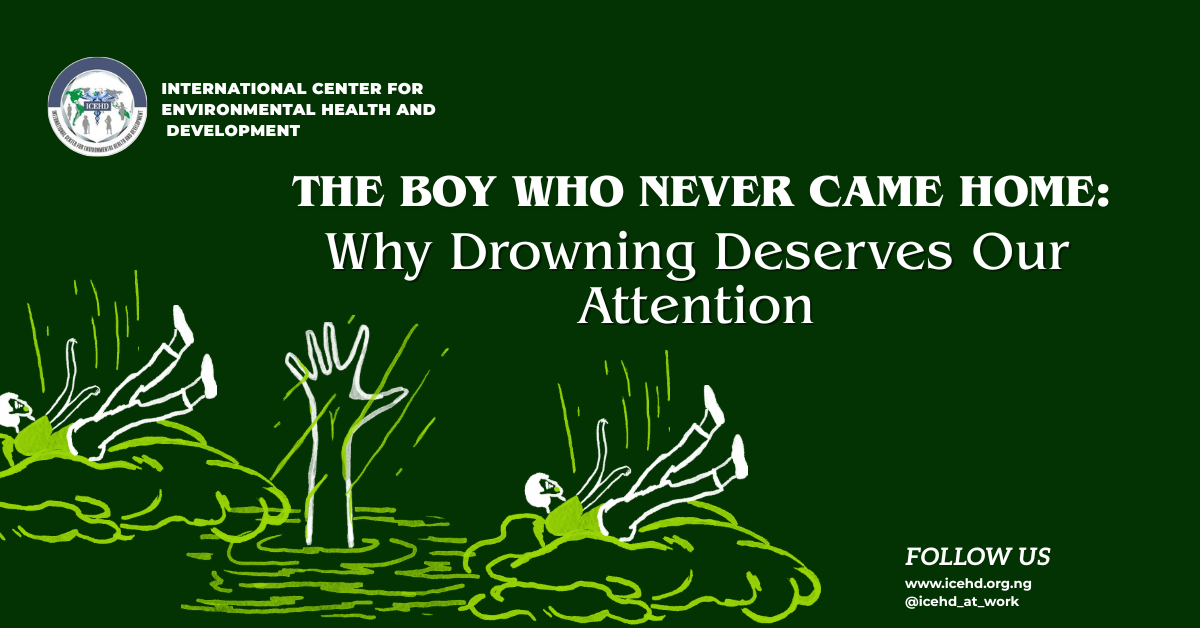
The sun was setting, painting the sky in shades of orange as ten-year-old Daniel raced toward the river with his friends. It was the school holiday, and like every other child in the village, he wanted one last swim before dinner.
His mother called after him, "Don't stay too long!"
He smiled, waved, and disappeared down the dusty path.
Minutes later, his friends came running back but Daniel wasn't with them.
"He went under," one of them whispered, struggling to catch his breath.
The entire community rushed to the river. Some jumped into the water. Others searched the riverbank with flashlights as darkness fell. His mother stood frozen, calling his name over and over, hoping he would answer.
He never did.
Daniel's story is fictional, but for hundreds of thousands of families around the world, it reflects a heartbreaking reality. Every drowning victim is someone's child, sibling, parent, or friend. Every life lost leaves behind dreams that will never be fulfilled and families that will never be the same.
On July 25, the world observes World Drowning Prevention Day, a day established by the United Nations to raise awareness about one of the world's most overlooked public health emergencies. It is not simply a day to remember those who have died it is a reminder that drowning is preventable and that every life saved begins with awareness.
The Silent Emergency
Unlike what movies often portray, drowning is rarely dramatic. There is usually no shouting, no waving for help, and no loud cries.
It happens quietly.
A person slips beneath the surface, struggling to breathe as water fills their airway. Within moments, a fun afternoon can become a lifelong tragedy.
Perhaps this is why drowning does not receive the attention it deserves. It is silent, but its impact echoes for generations.
The Numbers We Cannot Ignore
Statistics tell a story that words alone cannot.
According to the World Health Organization, around 300,000 people die from drowning every year worldwide. That means more than 800 people lose their lives every day, or more than 30 people every hour.
Even more alarming:
Nearly one in four drowning victims is a child under the age of five.
Drowning is the third leading cause of death among children aged 5–14 years and the fourth leading cause among children aged 1–4 years.
More than 90% of drowning deaths occur in low- and middle-income countries, where access to swimming lessons, rescue services, and water safety education is often limited.
Behind every percentage is a face.
Behind every statistic is a family forever changed.
Why Is Africa So Vulnerable?
Across many African countries, including Nigeria, water is part of everyday life. Rivers, lakes, streams, wells, and floodwaters surround many communities.
Children often play near open water while parents work. Fishermen risk their lives to provide for their families. Boats transport people across rivers without enough life jackets. During the rainy season, floods transform familiar streets into dangerous waterways.
These everyday realities increase the risk of drowning.
The WHO also notes that drowning rates remain particularly high in many low-resource settings where water safety policies, rescue services, and swimming education are limited.
More Than an Accident A Public Health Issue
Many people think drowning is simply "an accident."
Public health experts see it differently.
Like many diseases and injuries, drowning follows patterns. It affects certain age groups more than others. It occurs more frequently in communities with poverty, poor infrastructure, inadequate supervision, and limited access to emergency care.
That means drowning is not just about water.
It is about education.
It is about policy.
It is about prevention.
Climate Change Is Changing the Conversation
The climate crisis has made drowning prevention even more urgent.
Across the world, floods are becoming more frequent and more severe. Heavy rainfall, rising sea levels, and extreme weather events expose millions of people to dangerous water conditions.
Communities that have never experienced flooding before now find themselves vulnerable, making water safety education more important than ever.
The Good News: Drowning Is Preventable
Unlike many public health problems, drowning can often be prevented through simple, practical actions.
Experts recommend:
Teaching children basic swimming and water safety skills.
Never leaving young children unsupervised near water.
Wearing properly fitted life jackets while boating.
Avoiding alcohol or drugs during water activities.
Installing barriers around swimming pools and wells.
Training community members in safe rescue techniques and CPR.
Strengthening flood preparedness and emergency response systems.
These interventions have already saved thousands of lives in many countries.
A Responsibility We All Share
Governments have a responsibility to develop water safety policies.
Schools should include water safety education in their curriculum.
Communities should identify dangerous water bodies and educate residents
Parents and caregivers should supervise children closely whenever water is nearby.
Young people should learn swimming and rescue skills not just as hobbies, but as life-saving abilities.
Preventing drowning is everyone's responsibility.
Every Story Matters
Imagine if Daniel had been wearing a life jacket.
Imagine if an adult had been nearby.
Imagine if someone at the river knew CPR.
Imagine if his community had received water safety education.
His story might have ended differently.
Every year, World Drowning Prevention Day reminds us that the next drowning is not inevitable. It is preventable.
Because every statistic represents a human life.
Every life matters
And no family should have to wait on a riverbank, hoping for someone who will never come home.